Tether deepens AI bet, backs Italian firm’s humanoid robots

cointelegraphPublished on 2025-12-09Last updated on 2025-12-09

Abstract

Tether, the stablecoin issuer, has participated in a €70 million ($81 million) funding round for Italian AI startup Generative Bionics. The investment, led by CDP Venture Capital, supports the development of advanced humanoid robots designed for industrial performance and human-centric interaction. Tether's capital will help accelerate the development of Physical AI systems, the construction of a production facility, and integration into the broader robotics ecosystem. Generative Bionics, a spinoff from the Italian Institute of Technology, focuses on building robots with real-world AI capabilities for factory use. This investment aligns with Tether’s broader strategy of supporting emerging technologies that expand human potential and reduce reliance on centralized systems. The firm has been active in AI investments, including a potential $1.15 billion investment in German robotics startup Neura and initiatives in brain-computer interfaces and large-scale AI compute networks.

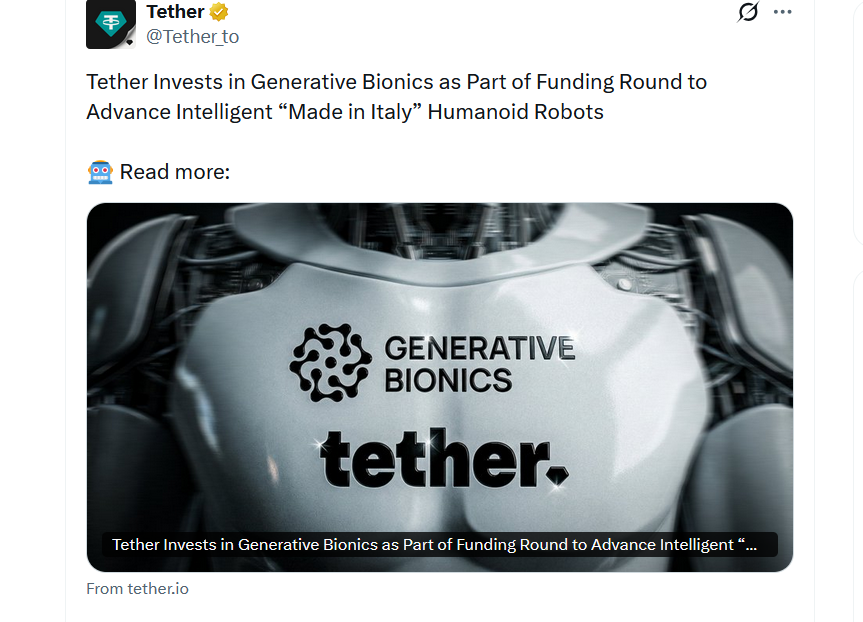
Stablecoin giant Tether has announced it is one of the backers of an $81 million funding round for an Italian artificial intelligence startup aiming to build advanced humanoid robots.

The 70 million euro funding round for startup Generative Bionics was led by the AI fund of CDP Venture Capital, with participation from Tether, AMD Ventures, Duferco, Eni Next and RoboIT.

In an announcement on Monday, Tether said it provided capital to support the development of advanced humanoid robots, “built for industrial scale performance” and “human-centric interaction.”

“Tether’s investment will support the development of Physical AI systems and edge AI solutions, and accelerate the industrial validation of the company’s humanoid platform, the development of its first production facility, and its integration in the broader robotics ecosystem,” Tether said.

Generative Bionics is an AI startup and research spinoff from the Italian Institute of Technology. Its focus is on building humanoid robots with “real-world physical AI capabilities” such as industrial usability in factory production lines.

“Tether’s support for Generative Bionics builds on its broader strategy to back emerging technologies that expand human potential while reducing reliance on centralized systems overseen by Big Tech,” Tether said.
Source: Tether

Related: Tether's USDt awarded key regulatory status in Abu Dhabi

According to Tether, the firm focuses on five areas of investment. These include: finance, power, data, education and evolution, with AI investments such as these falling under the category of evolution.

With a healthy balance sheet in 2025, the firm has made a series of investments across multiple sectors. In terms of AI, it was reported in mid-November that the firm was considering a hefty $1.15 billion investment in German AI robotics startup Neura.

In the announcement, Tether also highlighted some other AI plays it has supported.

“This includes investments in brain-computer interfaces via Blackrock Neurotech and recent AI initiatives such as Tether’s collaboration with Northern Data and Rumble to deploy a 20,000-GPU global compute network for open, privacy-preserving AI development,” Tether said.

Magazine: Opinion: Stablecoins will see explosive growth in 2025 as world embraces asset class



Related Reads

Bull vs. Bear Debate: Is the Profit Moat of Stablecoin Leader CRCL Solid?

The article presents a heated debate surrounding Circle (NYSE: CRCL), the issuer of the stablecoin USDC, focusing on the sustainability of its business model following its IPO and Q3 2025 earnings report. Key bearish points, led by figures like Jiang Zhuo'er, argue that CRCL's profits are unsustainable. They compare it to a bank reliant on an interest rate spread, which is highly vulnerable to Federal Reserve rate cuts. Critics highlight that over 60% of profits are paid to distributor Coinbase, leaving CRCL with a thin margin. They warn that competition from traditional financial giants like JPMorgan could easily disrupt its model, and that its regulatory advantage is a temporary benefit, not a permanent moat. Bullish commentators, including @BTCdayu and @qinbafrank, counter that CRCL is a long-term infrastructure play, not a simple bank. They believe current profit-sharing is a strategic cost to achieve market dominance and network effects, similar to companies like Amazon in their early days. They argue that future growth from massive USDC adoption (potentially reaching trillions) will far outweigh the impact of falling interest rates. They see compliance as a powerful, long-term moat that will eliminate smaller competitors. Additional short-term concerns include a significant sell-off pressure from the post-IPO lockup expiration and a structural barrier to USDC's use in U.S. retail payments due to its classification as a taxable asset. In summary, the debate pits short-term cyclical risks (interest rates, high costs, sell pressure) against a long-term structural opportunity (market growth, network effects, compliance as a barrier to entry). The core question remains whether CRCL's current model is a fragile interest-rate play or a foundational bet on the future of digital currency.

比推Hace 22 min(s)

Bull vs. Bear Debate: Is the Profit Moat of Stablecoin Leader CRCL Solid?

比推Hace 22 min(s)

Trading

Spot
Futures
活动图片